

* Starting in 2028, batteries sold into US Department of War programs will need to be assembled outside any China, built without Chinese-licensed technology, and sourced so that more than 95% of the cost comes from non-FEOC suppliers.
* China dominates nearly element of the battery architecture
* Coreshell mitigates geopolitical risk within every function of the battery
If your company builds anything with a battery in it, there's a good chance you're more exposed to China than you realize, even if you've never bought a single component directly from a Chinese supplier.
Batteries look like simple, self-contained units. In reality, they're assembled from highly specialized materials and subsystems, and China has spent the last two decades quietly building a near-monopoly across nearly all of them.
This isn't a speculative concern anymore. The Fiscal Year 2026 National Defense Authorization Act (NDAA) expands restrictions on Department of War procurement of batteries and materials tied to "foreign entities of concern" (FEOCs), a legal category that captures companies located in, or controlled by, China, Russia, Iran, or North Korea.
Starting in 2028, advanced batteries sold into DoW programs will need to be assembled outside any FEOC, built without FEOC-licensed technology, and sourced so that more than 95% of the cost comes from non-FEOC suppliers. Separately, IRS "Material Assistance Cost Ratio" rules are already squeezing the Investment Tax Credit available to energy storage projects, with the threshold for FEOC-linked content tightening every year through 2030.
In other words, whether you sell to the Pentagon, a utility, or a commercial fleet operator, where did a battery actually come from has real financial and legal consequences: lost tax credits, disqualified contracts, and compliance liability that can travel with a product for years after it ships.
Aside from NDAA, the geopolitical risk of depending on components sourced exclusively from Chinese companies has become undeniable. The Chinese government has a well-documented history of restricting exports of critical minerals and components to achieve geopolitical or economic objectives. Whether a US-based company is selling to the military or not, it behooves them to comprehend and mitigate the risk of dependency on unreliable foreign entities.
To understand why this is so hard to untangle, it helps to know what's actually inside the battery in the first place.
A 60-second primer on how a battery is built
Strip away the marketing language and a lithium-ion battery comes down to four core components working together inside a cell:
- Cathode: the positive electrode. This is where most of the battery's cost and performance characteristics (range, power, safety) have been historically determined.
- Anode: the negative electrode, typically made from graphite, where lithium ions are stored during charging.
- Electrolyte: the medium that lithium ions travel through to move between the anode and cathode.
- Separator: a thin, porous membrane that physically keeps the anode and cathode apart to prevent short circuits, while still letting ions pass through.
Individually, none of these components look like a geopolitical flashpoint. Collectively, they're where nearly all of a battery's value – and nearly all of the compliance and supply chain risk – actually live. One widely cited DOE-linked analysis found that more than 90% of U.S. battery energy storage systems contain at least one Chinese-sourced component. And roughly two-thirds of global Tier 1 battery vendors are actually headquartered in China.
Where China sits in each layer
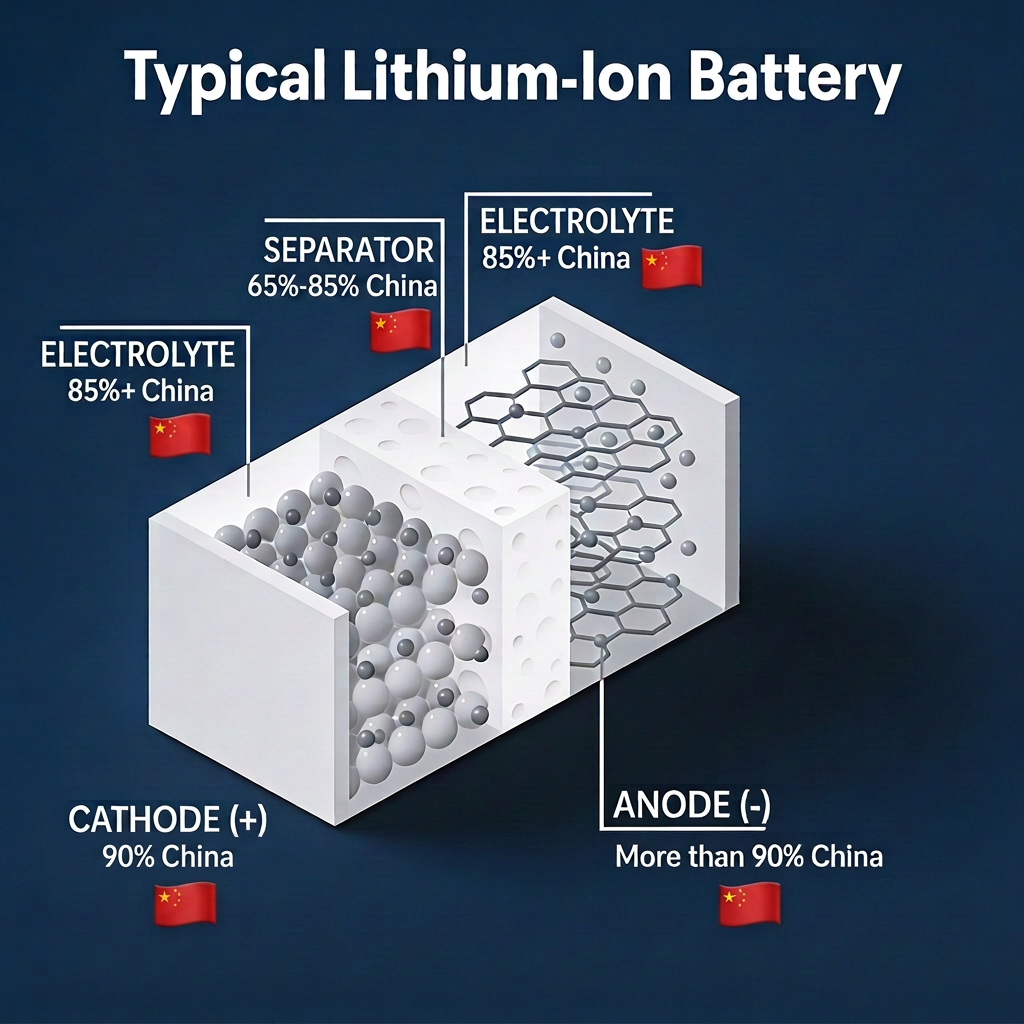
Anode materials and graphite: more than 90% Chinese-controlled.
This is arguably the single biggest headache for compliance teams. Natural and synthetic graphite processing is overwhelmingly concentrated in China, and the material is genuinely hard to trace: it gets blended and commingled early in the supply chain, which is part of why U.S. tax regulators granted graphite a temporary carve-out from strict tracing requirements for EV tax credit purposes. That carve-out is set to expire, and in the meantime the U.S. has already raised tariffs on Chinese natural graphite from 0% to 25% as of January 2026 – a signal of where policy is headed.
How Coreshell removes geopolitical risk from the anode: Coreshell eliminates Chinese graphite entirely, replacing it with metallurgical silicon, a domestically abundant material already produced at roughly 100,000 tons per year in the U.S. A patented solution solves the swelling and degradation that has historically kept silicon out of commercial cells, delivering a 10x increase in specific capacity over graphite, a 30% gain in energy density, and up to 50% lower material costs. The result is an anode platform that is already 100% American-produced and NDAA Section 842-compliant.
Cathode materials: roughly 90% Chinese-controlled.
The cathode is the single most expensive part of a battery cell, and China dominates both the raw refining and the finished "cathode active material" production, especially for lithium iron phosphate (LFP) chemistry. LFP has become the default choice for stationary storage and increasingly for EVs because it's cheaper and doesn't require cobalt, a mineral with problematic sources and high financial and environmental costs. China also processes the large majority of the world's cobalt and a substantial share of the nickel used in nickel-manganese-cobalt (NMC) cathodes, even when the raw ore is mined elsewhere, like the Democratic Republic of Congo or Indonesia.
How Coreshell mitigates geopolitical risk in the cathode: Coreshell sources its LFP and LMR (lithium manganese-rich) cathode materials from the U.S. and South Korea. A newly announced eight-year supply agreement with L&F secures a long-term, non-FEOC source of LFP cathode active material, closing yet another potential FEOC exposure point in the stack. Combined with its exclusive anode technology, Coreshell can now offer a battery platform that's FEOC-compliant at both of the most expensive and highest-risk layers of the cell.
Electrolyte: roughly 85–90% Chinese-controlled.
The electrolyte requires specialized lithium salts and solvents that are manufactured at scale almost exclusively in China. This layer gets less attention than cathodes and graphite, but it's just as concentrated, and China's decision to cancel its VAT export rebate on lithium batteries in 2026 has already started raising the effective cost floor for electrolyte and cell exports.
How Coreshell mitigates geopolitical risk in the electrolyte: Coreshell sources all of its electrolyte from reliable suppliers in South Korea and the United States, avoiding the Chinese-dominated salt and solvent supply that underpins most of the industry. Paired with its non-FEOC anode and cathode materials, this closes another major gap in building a fully China-free cell.
Separators: roughly 65–85% Chinese-controlled, depending on grade.
Separator manufacturing is technically demanding, and while South Korea and Japan hold meaningful market share in the highest-performance coated separators, China supplies the majority of global volume, particularly for cost-sensitive applications like stationary storage.
How Coreshell mitigates geopolitical risk in the separators: Coreshell sources its separators from a supplier that manufactures the material in South Korea, keeping this layer outside Chinese control as well. Combined with its anode, cathode, and electrolyte sourcing, this gives Coreshell a battery platform that is non-FEOC across every core material in the cell.
"NDAA compliant" doesn't necessarily mean “safe from geopolitical disruption”
Here's the trap a lot of buyers fall into: a supplier says its battery is "NDAA compliant," the pack is bolted together in a U.S. facility, and the paperwork checks out at a glance. Case closed, right? Not necessarily.
Final assembly location is only one input into compliance, and it's the easiest one to satisfy without actually solving the underlying problem. A cell can be assembled in the US using a cathode that was refined in China, a separator coated with Chinese-origin material, or graphite that’s been laundered through two or three intermediaries before landing at a "non-FEOC" supplier's door. None of that shows up if the only question being asked is "where was this battery put together?"
The NDAA's own compliance bar is built around cost-weighted content, not assembly geography. To qualify, a battery has to be assembled outside any FEOC, built without FEOC-licensed technology, and sourced so that more than 95% of the cost comes from non-FEOC suppliers, a standard that requires tracing value through every material layer, not just checking a "assembled in the USA" box on the finished pack.
There's also a subtler version of this problem: buying "intermediate" components from a non-FEOC country doesn't automatically clear a battery either. A cathode or separator manufacturer based in South Korea or Japan can still be sourcing its own precursor materials, salts, or raw ore from China. Unless a supplier can show documentation for where the value was created at each tier, not just which country shipped the final component, that Chinese exposure simply moves one step back in the chain instead of disappearing.
Graphite is the clearest example: it's commingled early and is genuinely difficult to trace, which is exactly why regulators carved out a temporary exception for it in the first place, and exactly why that carve-out is being phased out. It’s also why Coreshell uses no graphite at all in its cells, relying entirely on metallurgical silicon, which is cheap and abundant in the US and traceable all the way to the mine.
The practical upshot for buyers and compliance teams: "assembled in the U.S." or "sourced from a non-FEOC country" are necessary claims, but neither one is sufficient on its own. The only way to know whether a battery is actually compliant, rather than compliant-sounding, is to ask for component-level, cost-weighted, attestable sourcing data all the way back through the supply chain. A supplier that can produce that documentation is telling you something real. A supplier that can only point to where the pack was bolted together is telling you where the last step happened, and not much else.
Not all "silicon anodes" are created equal
The industry loves to reference "silicon anode" as if it's a single technology, but the differences under the hood determine whether a solution actually solves the China-exposure problem or just relabels it.
Some well-funded competitors that claim "silicon anodes" synthesize silicon by breaking down silane gas onto a carbon scaffold, or by grinding silicon down to a fine powder and mixing it with carbon. Others grow tiny silicon wires directly on a carbon fiber base instead of depositing or grinding particles. These all have significant disadvantages against MGS.
Cost. Nano-engineered synthetic silicon can run up to 20 times more expensive than graphite. That cost profile is why these materials have mostly stayed confined to price-insensitive niches. Coreshell's metallurgical silicon (MGS), by contrast, is only milled to the micron scale (further milling to nanoscale is where the cost curve becomes prohibitive) and runs at roughly $1 per kilogram, about half the cost of graphite, while still delivering a 10x increase in specific capacity. An independent Roland Berger analysis estimated Coreshell’s cells built with MGS are 15%-25% cheaper than graphite-LFP prismatic cells or graphite-NMC 4680 cells.
Scalability. Silane-based and CVD processes are capital-intensive, yield-constrained, and slow to scale; total silicon anode capacity outside China was only around 7.5 kilotons by the end of 2025. Metallurgical silicon starts from an unprocessed, naturally abundant material already being produced domestically at roughly 100,000 tons per year, and it's compatible with existing battery manufacturing lines rather than requiring new, specialized production infrastructure. That's the difference between a material that scales at the pace of a chemical plant buildout and one that scales at the pace of existing industrial capacity.
Ability to fully displace Chinese graphite. This is the part that most battery companies try to gloss over. Many synthetic “silicon” products are actually silicon-carbon (Si-C) composites. A battery built around a Si-C composite still depends on graphite and the underlying FEOC vulnerability. Coreshell's approach replaces graphite entirely: there's no residual graphite content to trace, document, or worry about as tracing rules tighten. For a buyer, "reduced graphite" and "zero graphite" are not the same compliance posture, even if both get marketed under the same "silicon anode" banner.
What this means for suppliers to the DoW
A few practical takeaways, regardless of which end market you serve:
- "Assembled outside China" is not the same as "compliant." A pack can be bolted together domestically while every material inside it traces back to a FEOC. Regulators are increasingly looking at actual material content, not just final assembly location.
- Graphite and cathode precursors are the sleeper risks. These are the components most likely to be commingled, hardest to trace, and currently subject to the most regulatory flux, which makes them the most likely source of a compliance surprise later.
- The rules are still tightening, not settling. Material thresholds (MACR) step up every year through 2030, the graphite tracing carve-out is temporary, and the NDAA's FEOC battery restrictions phase in through 2028. A supply chain that's compliant today may not be compliant in eighteen months.
- Documentation now beats explanation later. Whether you're chasing a tax credit, a defense contract, or simply trying to reassure a customer's procurement team, the companies that can show component-level, attestable sourcing data are going to have a real commercial advantage over those that can only offer assurances.
The battery supply chain didn't get this concentrated by accident, and it won't get un-concentrated quickly. But for companies willing to do the diligence – and increasingly, for companies that have no choice but to do it – understanding exactly which layer of the battery carries the risk is the first step toward actually managing it.
Eric Meyerson, eric@coreshell.com